Private networks (VPCs)
Servers you attach to a VPC talk to each other over a private address range that never touches the public internet — database traffic, clustering, internal APIs, and anything else you'd rather keep off the wire.
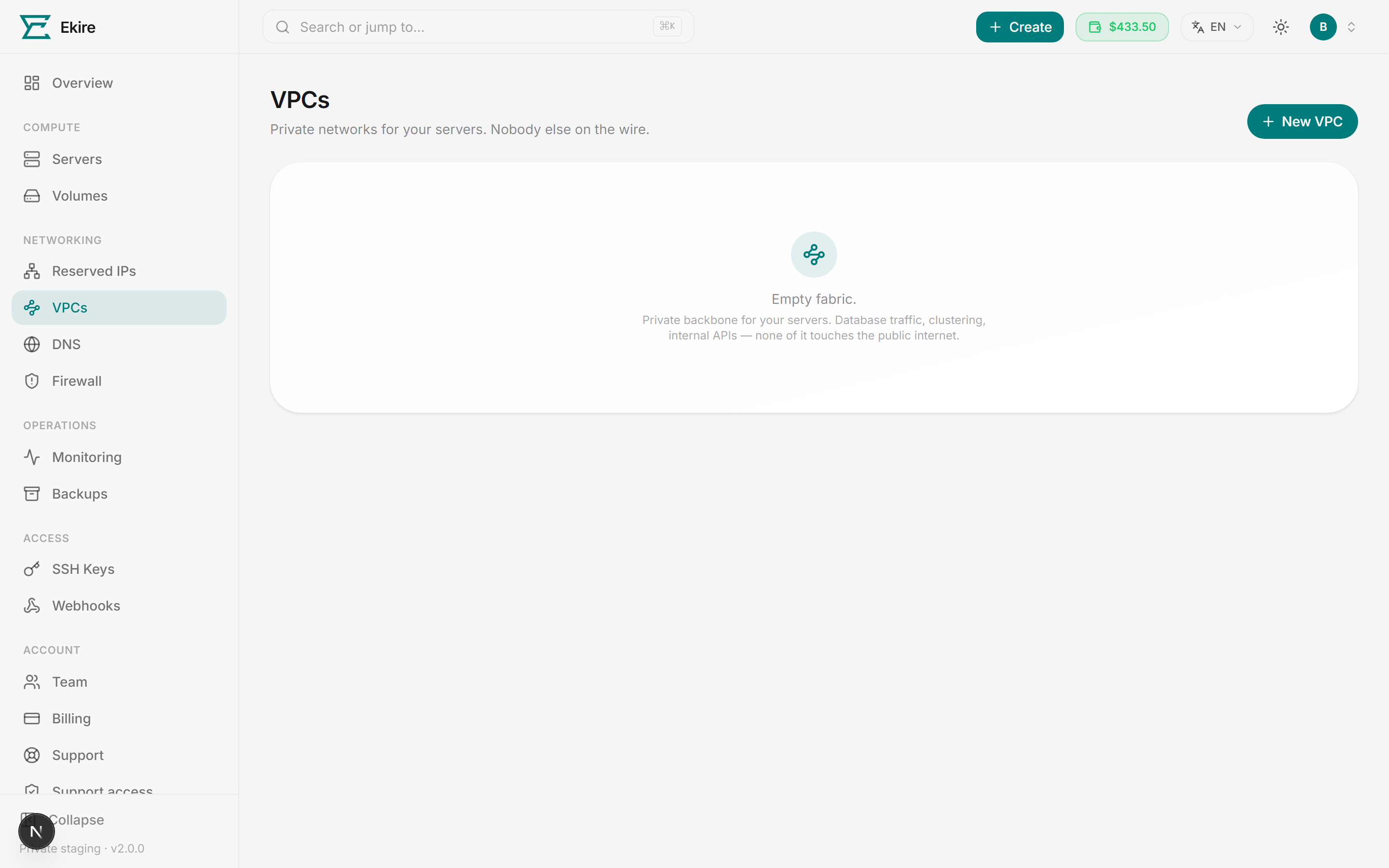
What a VPC gives you
VPCs live under Networking → VPCs. Each VPC is a software-defined private network with:
- A name you choose (for example,
prod-backend). - A private range (CIDR) — the block of addresses servers on the network use, like
10.10.0.0/24. - An optional region, so the network sits close to the servers that use it.
- A status — a VPC shows Active once it's ready to use.
Once a VPC is active, you attach servers to it. Attached servers reach one another by their private addresses, with no public routing in between.
Create a VPC
Click New VPC and fill in the short form.
Name it
Give the network a name that says what it's for, like prod-backend. It only needs to be meaningful
to you.
Set the private range (CIDR)
Choose the address block servers on this network will use — the default is 10.10.0.0/24. Every server
you attach gets a private address from this range. Enter it in CIDR form with a mask between /16 and
/30, such as 10.10.0.0/24.
Pick a region
If more than one region is available, choose where the network lives. This sets which servers can join: a server must be in the same region as the VPC, and attaching one from another region is rejected with an error.
Create
Confirm, and the VPC is provisioned. It appears in your list and flips to Active when it's ready.
You can hold up to 5 private networks.
Attach and detach servers
Open a VPC's Servers panel to manage what's connected. Only servers that are running or stopped can be attached, and a server that's already on the network won't appear in the list again.
Choose a server
In the VPC's Servers panel, pick a server from the Choose a server… dropdown.
Attach & reboot
Click Attach & reboot. We add a private NIC to the server and reboot it so the new interface comes up. The server shows Attaching… until its network slot is ready.
To remove a server, click Detach & reboot next to it in the same panel. Detaching removes it from the private network and frees its private address. Like attaching, this removes the private NIC by power-cycling the server, so expect the same brief interruption while it reboots.
Attaching reboots the server
Attaching a server adds a network interface and reboots it. Plan attachments for a moment when a quick restart is fine, and expect a brief interruption while the server comes back up.
Private IPs are assigned for you
You don't pick per-server addresses. When you attach a server, we assign it a private IP automatically from
the VPC's range (IPAM) and show it next to the server in the Servers panel. Detach a server and that address
is released back to the range. The first two addresses in the range and the broadcast address at the end are
never handed out, so a /24 gives you hosts .2 through .254.
If the range has no free address left, the attach is refused rather than rebooting a server onto a NIC with no address. A VPC's range is fixed once created, so pick a larger CIDR up front if you plan to grow past it.
Automatic private addressing
Every attached server gets a private IP from the VPC's CIDR block automatically. Use these private addresses when you wire up services that should stay internal.
Delete a VPC
You can delete a VPC once it has no servers attached — the delete control stays disabled while any server is still on the network, so detach them all first. Deleting asks you to type the network's name to confirm.
Deleting removes the network
Deleting a VPC tears down its private network and can't be undone. Detach every server first, then delete. The attached servers keep running; they just lose their private interface on this network.
If the teardown fails, we keep the VPC rather than lose track of a network that's still out there: it stays in your list with a Teardown failed chip, refuses new attachments, and you can run the delete again.